
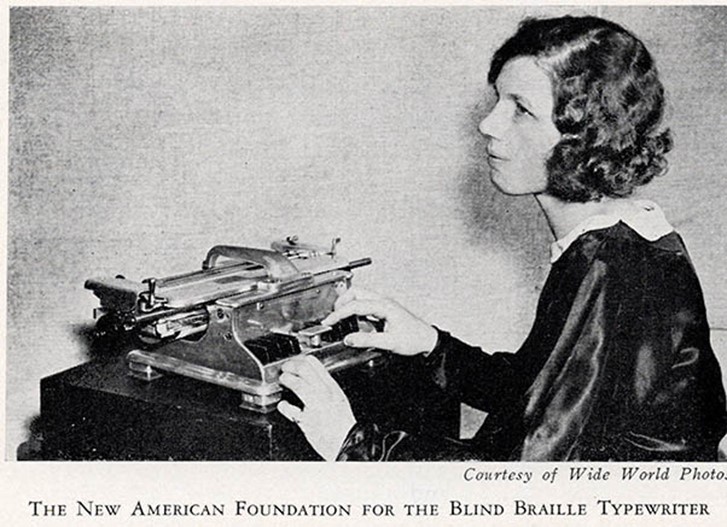
An ad for a braille typewriter designed by AFB to expand employment opportunities.
The Council’s highly trained vision rehabilitation professionals empower people who are blind or low vision to live life on their own terms in a variety of ways. They help clients gain the skills to navigate safely through their community, use access technology to land a job, use magnification to read prescription labels; and much more.
But throughout its history, the work of vision rehabilitation professionals has been undervalued by society, particularly the medical establishment. The history of the profession, as outlined in the textbook Foundations of Rehabilitation Teaching, shows a pattern of underpaid labor, creating the impression that the work had little value. That perception persists in some circles today.
Vision rehabilitation as we know it today began in America in 1882 at the Philadelphia School of the Blind. This work was done through “home teaching,” where blind workers, mostly women, would travel to the homes of people with vision loss to teach them how to live independently. There was no textbook or set of standards guiding what was taught. Instead, these skills were passed down from teacher to teacher as a form of mutual aid for other people with vision loss. Home teachers taught everything from braille to daily living skills to crafts, but also took on extra duties similar to those of a social worker, such as case work and counseling.
Though their work was vital to uplifting the lives of people who were blind or low vision, they were often severely undervalued. Most women could expect to be paid just $1 a day for their work (around $38 in today’s money) and had to travel with sighted guides paid for out of their own pockets. It wasn’t until the 1930s, when two member organizations—the American Foundation for the Blind (AFB) and the American Association of Workers for the Blind (AAWB)—met to set nationalized standards for home teachers and vision rehabilitators, marking the beginning of formalized training.
Standards were first put forward in 1941 and included both two-year and four-year instruction. For the first time, vision rehabilitation specialists had a curriculum to follow to ensure that people were receiving adequate services. Over the following decades, these standards were refined to better serve the needs of people who were blind or low vision across the country.
When veterans began returning home from World War II with vision loss, the federal Veterans Administration (VA) started training their staff in orientation and mobility (O&M) instruction. In 1959 the VA and AFB met to begin establishing university training programs for blind rehabilitation. Western Michigan University (WMU) offered the nation’s first university-based training program in vision rehabilitation in 1963, and soon both Boston College and WMU began the first formal university level O&M training programs. Other universities followed.
More than 50 years later, these certifications are still in use today, though they have gone through countless updates since then. Certifications exist today for many professions in the blind and low vision field, including Certified Low Vision Therapist, Certified Vision Rehabilitation Therapist, Certified Orientation and Mobility Specialist, Certified Assistive Technology Instructional Specialist and Certified Deafblind Intervenor Specialist. Those who graduate from these programs must take a competency exam to establish that they are qualified to provide high-quality service and must engage in continued education and recertification every two to five years, depending on their specialty.
But this history of undervalued labor brings consequences that persist to this day. Vision rehabilitation services are still not covered by Medicaid, Medicare or most other insurance. Additionally, there is a severe shortage of certified professionals across the country. Starting wages for new vision rehabilitation specialists remain extremely low, averaging around just $30,000 a year. Universities are not offering new programs to train vision rehabilitation professionals, and many people are unaware that these professions exist. This has consequences for the people who need these services, as too few new qualified professionals are being trained to replace those who retire.
While the Council is proud to have certified vision rehabilitation professionals on staff, there is still a severe shortage of qualified professionals across Wisconsin. Throughout the state, there are free informal trainings within the blind and low vision community to fill in gaps where quality services are not available. While these are done with the best intentions, there can be unintended negative consequences. Often this free training goes beyond what should be done by a non-professional. Meanwhile, it creates the false impression that the training should be free of charge even when conducted by a skilled, certified provider.
If qualified instructors are available to people, they would be less likely to resort to this peer-to-peer instruction. To grow the number of certified vision rehabilitation professionals, more must be done to recognize and honor their work. Once their value is better understood, the field can begin to gain more recognition from the medical and insurance industries. In turn, the field can then expand to meet the growing demand for vision rehabilitation services.
The number of people with vision loss will continue to grow briskly in the coming years, and it is important that everyone has access to the quality vision rehabilitation services they deserve, provided by certified professionals who can ensure they are getting the training and support they need.