
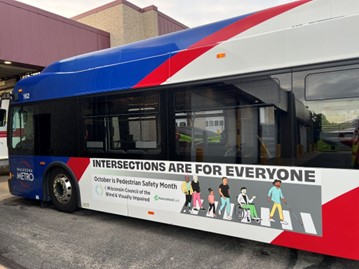
October is Pedestrian Safety Month, a time to raise awareness about how communities can become safer and welcoming for pedestrians. While everyone is a pedestrian some of the time, pedestrian safety is especially critical for the 31% of state residents who do not drive, including people who are blind or low vision. There are a number of critical pedestrian safety infrastructure improvements you can advocate for in your community to make your streets safer for all.
When advocating for pedestrian safety infrastructure, it is important you use the correct terminology. If you don’t know the correct terms for a piece of infrastructure, you might be asking for the wrong thing. And you will be more likely to be taken seriously right away if you use the correct names and terms.
Curb ramps are the part of the sidewalk that ramps down into the street, telling pedestrians where to safely cross. Curb ramps also include a tactile warning field, which is a brightly colored tactile surface which can tell cane and guide dog users they are entering a crosswalk. Curb cuts are similar to curb ramps, but do not include the tactile warning field. When talking to your local leaders, be sure to ask for curb ramps to be installed in your neighborhood.
It is best practice to place one curb ramp at each crosswalk, as curb ramps also provide directional guidance to the pedestrian. Many communities are installing “blended transitions” at intersections, where the entire corner of sidewalk ramps down into the road. While good for those using a mobility device, this can make it very hard for cane users to know whether they are actually walking in the crosswalk or through the middle of the intersection. Even if a blended transition intersection has tactile warning fields in front of the crosswalks, these can be missed by blind or low vision pedestrians.
Accessible pedestrian signals are placed at both traffic controlled and uncontrolled intersections to give audible information about the street crossing. These signals tell pedestrians when it is safe to cross and can give other information such as street names as well. At controlled intersections, such as those with traffic lights, accessible pedestrian signals are often automatic and will tell the pedestrian when they have a walk signal. At uncontrolled intersections, pressing a button will trigger rectangular rapid flashing beacons (RRFB) that will flash bright lights to let drivers know someone is trying to cross the street. Some will also provide a haptic response that can be felt by the pedestrian, like a buzz or shake, which is especially helpful for people who are deafblind.
There is no universal design for accessible pedestrian signals. When talking with your local leaders, be specific about what would be helpful to you when crossing an intersection and ask that all signals in your community be uniform. The best accessible pedestrian signals will audibly tell you when the walk signal is active and provide street name information, provide haptic feedback, and beep at both ends of the intersection to help you know your relative location within the crosswalk.
Connected sidewalk networks have sidewalks on both sides of all streets. This enables pedestrians to get to wherever they need to go safely with as few street crossings as possible. When a street only has sidewalks on one side, or on alternating sides, a pedestrian will need to put themselves at unnecessary risk crossing a street just to stay on the sidewalk. When advocating for connected sidewalk networks in your neighborhood, share your own story with local leaders. Give specific examples about where on your regular commute you need to cross the road and where the sidewalk ends.
When advocating for pedestrian safety infrastructure in your neighborhood, it can be hard to know who to talk to. Talking to the wrong person can waste time and resources. Start by reaching out to the most local elected official for your immediate area. For larger cities, this would be a city alder or councilperson. In smaller towns it may be your representative on the town board. They are elected to serve your needs and can help you navigate local government.
Once you’re on the right path, there are some levers already in law that can help you in your advocacy journey. Public entities that have 50 or more employees, such as most urban municipal governments, are required to have an Americans with Disabilities Act (ADA) Transition Plan that guides them on how to implement accessibility standards. They are required to update this plan every year, and you can communicate to them what you would like to see in your community.
Another option is to use the ADA’s Pedestrian Right-of-Way Access Guidelines (PROWAG), which guide municipalities on best practices for making their streets accessible. All municipal governments are required by law to follow PROWAG whenever they work on their public rights-of-way. If there is work being done on the streets in your neighborhood, talk with your local leaders about how they can use PROWAG to make them more accessible to all pedestrians.
You can learn more about how you can call for pedestrian safety infrastructure in our new Pedestrian Safety Toolkit, or on our Pedestrian Safety Month / White Cane Safety Day page.