
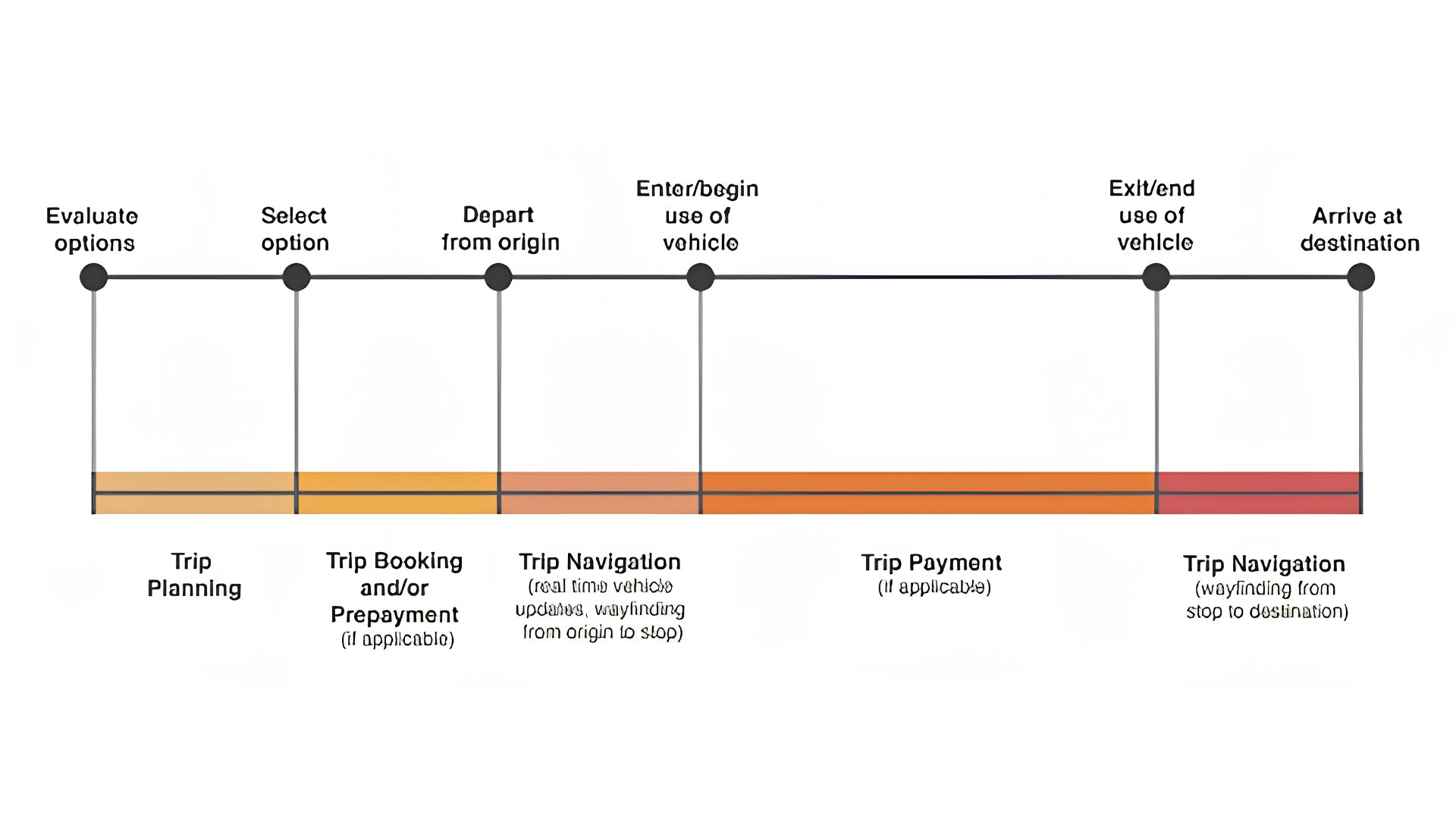
For nondrivers, including older adults, people who are blind or low vision and people with other disabilities, public transit and pedestrian infrastructure are essential to getting wherever they need to go. But even when a mode of transportation is available to a person’s destination, some portion of the trip may be inaccessible. Paying for bus fare online, calling to schedule a paratransit ride, and traversing interconnected sidewalks are examples of necessary steps in a trip that may present barriers. One way to address the accessibility of all parts of a trip is to apply the Complete Trip framework.
The Complete Trip framework was originally developed by the U.S. Department of Transportation. It demonstrates the importance of accessibility in every step of a trip, from planning all the way through arrival at the destination, taking into account every part of the transportation system. This often means having to coordinate multiple municipal departments so that everyone is on the same page. It’s great if your bus stop is fully accessible, but if there is no safe sidewalk leading to it, that won’t do you much good. If just a single small component of a trip is inaccessible, that trip may become impossible.
Inaccessible websites, lack of sidewalks, and a lack of options for travelling between municipalities all create major barriers. Here are a couple of situations that illustrate the value of the Complete Trip framework.
- A man lives in a residential neighborhood a few miles outside of town and uses a bike to get around. The town has an all-ages and all-abilities trail that enables people living in town to get anywhere they need to go, but that trail ends at the edge of town. It does not reach the man’s home, and there is no bike lane on the highway to enable him to ride safely to where the trail begins. The man will likely still make the trip, because he needs to get into town, but riding his bike on the side of the highway puts him at risk of an accident. This could become a complete trip by finding a way to connect the county highway near his home to the municipal trail in town.
- A woman with vision loss lives in a city and takes the bus to work every day. Due to heavy construction on her bus route, the bus now takes a detour, and several stops have been either moved or eliminated. The only way this is communicated to riders is by a printed sign, which the woman cannot read. This information should be shared audibly so that the woman knows where she needs to get off. It would also benefit her to know about the detour in advance so that she can familiarize herself with the walk from the temporary bus stop to her destination.
Complete Trips make travel safer for everyone that uses any form of transportation, while also freeing up resources for local governments. If people don’t feel safe on their route, they often turn to paratransit to get them to where they need to go. Paratransit services cost more than other transportation options and require significantly more planning. But there may only be a small part of the route that feels unsafe. If that one component of the trip can be made more accessible, the individual may feel confident enough to use a more cost-effective service and be less reliant on paratransit.
Advocates can use the Complete Trip framework to push for the system they want in their own communities. Whenever a new transportation system is being developed or the pedestrian infrastructure around you is being updated, approach the project leaders and ask them about accessibility. It’s a lot easier to make a system accessible up front during the planning process than it is to work it in after the project is complete. Working with project leaders to apply the Complete Trip framework to any transportation project ensures that everyone in your community can get where they need to go safely.
If you would like to learn more about the Complete Trip framework, the National Center for Applied Transit Technology wrote an in-depth review. You can find it on their website.