
September is Guide Dog Awareness Month, a time to recognize the importance of guide dogs in the lives of people who are blind or low vision. The relationship between a guide dog and their handler is both a working relationship and one of trust, love and discipline. Guide dogs go through extensive training to learn to guide their handlers through busy streets without distraction. While guide dogs are immensely beneficial to some people with vision loss, they are not an appropriate navigational tool for everyone. If you are considering getting a guide dog, it’s important to understand their unique needs and the work you need to do to keep both yourself and your dog safe.
It’s important for potential guide dog owners to have realistic expectations about what a dog can and cannot do. A dog won’t know exactly what building you’re trying to go to, or when you have the walk signal at an intersection. “A guide dog, for the most part, is there to replace a white cane,” says Certified Orientation and Mobility (O&M) Specialist and Certified Vision Rehabilitation Therapist Brent Perzentka of the Council. “A dog will help you avoid obstacles and stay within a crosswalk and navigate some trained routes quicker than you may be able to with only a cane. It’s up to you as the user to know when to cross the street, or where it is that you’re trying to go.”
Guide dogs are an expensive tool. It can cost as much as $50,000 to train a highly skilled animal. That expense is generally covered by the school. But the ongoing costs for things like food, veterinary care, and anything else needed to keep a dog happy and healthy fall to the user.
To be a good guide dog handler, you must have strong O&M skills and be able to confidently use a cane to get where you need to go. In fact, many guide dog schools will insist that a potential handler has received training from a certified instructor before even considering them for a dog.
Without constant reinforcement, a guide dog will begin to forget its training and get distracted by people and other animals, potentially leading you into harm’s way. It’s recommended that guide dog users walk at least two miles every day so that their dog can stay sharp in its training. That means you must be in adequate physical shape to walk two miles every day at the dog’s pace. Guide dogs are most beneficial to working people in urban areas who regularly use multiple specific routes. People in quieter, rural areas may still benefit greatly from a guide dog, but it’s important to evaluate your life situation to ensure you dog will get the necessary reinforcement.
“Think about where you are walking on a daily basis,” Brent says. “If you live in a city where there’s sandwich boards and chairs and clutter on a sidewalk, you’ll likely move a bit slow using your cane. A guide dog can help you quickly avoid all those obstacles. But if you live in a quiet neighborhood, a guide dog may not have the regular reinforcement it needs to stay sharp just walking on a clear empty sidewalk. A guide dog is just like a lot of people in that they need to regularly use their skills to retain them.”
When a guide dog loses some of those skills, it can put both you and the dog in danger. The dog may lead you off course or unexpectedly lunge at another dog while you’re holding the harness and cause you to fall. If your guide dog is not well trained, or if you do not have the O&M skills to reorient yourself if the dog gets off track, you run the risk of injury.
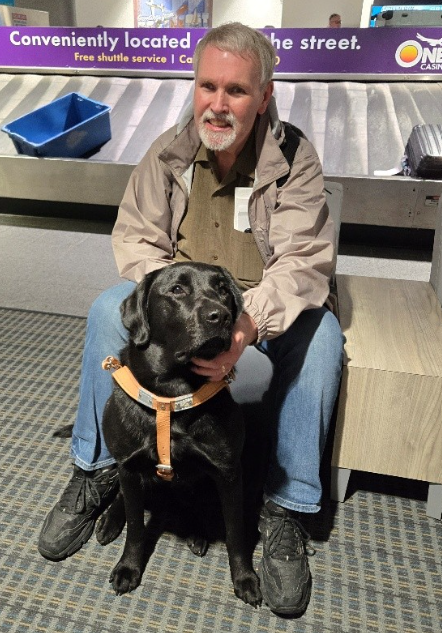
It takes a lot of trust between dog and handler for both to feel confident moving through the community. Council Board member Jim Unger got his first guide dog in 2014 as his vision deteriorated to the point where he didn’t feel safe walking in his community. Jim goes on long walks regularly through his neighborhood and already had great O&M skills, but because he couldn’t see obstacles in his path, he began to move more and more slowly. After a lot of training, including a weeklong retreat to work through every possible situation he could encounter, Jim’s guide dog allowed him to continue his walks with confidence. “My guide dog is another tool that I can use, just like my O&M skills and GPS,” Jim says. “You really need to do your homework and learn to trust the dog to do its job once that harness goes on. It’s not the be-all-end-all, but my dog is great for my lifestyle.”
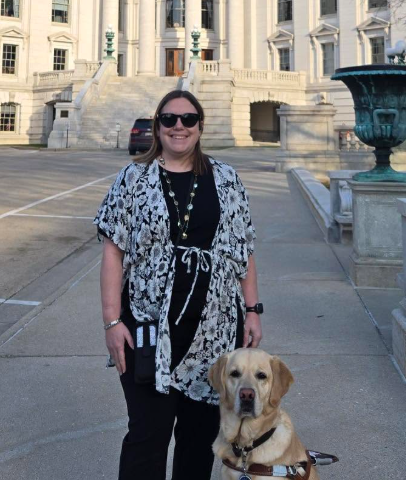
Board member Liz Fryseth has had her current guide dog for about four years. Liz uses her guide dog every day to travel around La Crosse to go to work and meet with people throughout her community. Her relationship with her dog is one of patience and trust. “Sometimes I’ll question what she is doing, and sometimes she’ll question what I’m doing,” Liz says. “But that trust in each other is what makes us a team. It’s an extremely personal choice to have a guide dog, and it won’t be for everyone. But for me, it gives me freedom and independence that I wouldn’t have without her.”