
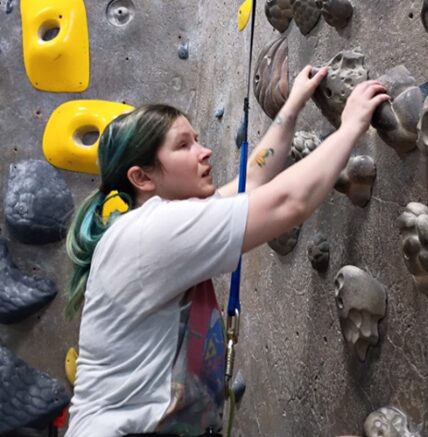
Christina Wilson working her way up the wall at Boulders Climbing Gym.
Before losing her vision, Christina Wilson loved being active in the outdoors. After her vision deteriorated from a macular pucker, however, she struggled to be able to maintain her independence while doing the outdoor activities she loved. That’s when Christina heard about adaptive rock climbing. After attending a free adaptive climbing class at Boulders Climbing Gym in Madison earlier this summer, Christina now climbs twice a week. “Rock climbing was the first time I actually felt independent in an outdoor activity since losing my vision,” Christina says.
Boulders has been offering their free monthly adaptive climbing class since 2014. Over a decade later, the classes still bring in both newcomers and seasoned climbing veterans. Rock climbing might seem like a sport that’s inaccessible to anyone with a physical disability, they say, but it’s actually the opposite. Kathryn Floyd, who helps run the adaptive climbing program, says they welcome anyone with any physical disability to come and learn to climb. “I really like seeing people push their boundaries and get into an adventure sport,” Kathryn says. “For us guides, it’s a lot of problem-solving because everyone’s a bit different. We have to figure out what techniques will work for each climber, but we make it work.”
People with all kinds of physical disabilities participate in Boulders’ adaptive climbing program, and there are several blind or low vision climbers who come every month. Maggie Groshan, a member of the Council’s Board of Directors, has been going to Boulders for around two years. “It really feels like the perfect sport for people who are blind or low vision,” Maggie says. “There’s really very little adaptation that needs to be done. It’s so fun and freeing.”
The key to climbing for people with vision loss is constant communication between the climber and the belayer, the person on the ground holding the rope to catch the climber if they fall. Most climbers use a belayer, but for climbers with vision loss, they are vital. As the climber makes their way up the rock wall, the belayer will call out where to find the next foothold or ledge to grab. For example, they may tell the climber that the next ledge to grab is for their right hand at two o’clock.
The belayer will also call out different obstacles and features of the wall. If there is a section of the wall that juts forward, they will call out “Jut out right above three feet up.” They will also call out the different types of rocks the climber needs to grab next.
Climber don’t just need strength and patience to hold on while the belayer searches for their next move; they also need complete trust in their partner to get them to the top. “I’ve had the same belayer for several months now, and I have to trust him with everything,” Maggie says. “Not only will they catch me if I fall, but they are also my guide for where I need to go next.”
Nobody will say that rock climbing is easy, but it can be a sport where people with vision loss can be just as independent as their fully-sighted peers. For Christina, climbing has given her the same feelings of being active outdoors as she had before losing her vision. “Rock climbing has been one of the things I can say has brought my independence back when it comes to exercise,” she says. “The community has been great, and everyone’s very friendly. I love it!”
If you would like to learn more about the adaptive climbing program at Boulders Gym on Madison’s east side, you can email them at [email protected]. You can also find guides on how to climb with vision loss at VIClimbing.com/Info-Guides. If you are outside the Madison area, consider reaching out to a climbing gym closer to where you live to begin a conversation about adaptive climbing. Then grab a partner and get climbing!