
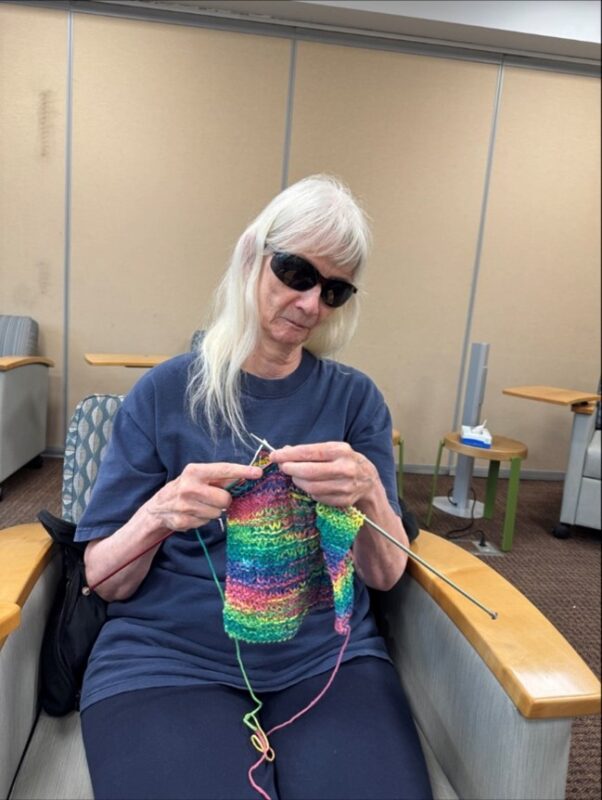
Judith Rasmussen
Judith Rasmussen first learned how to knit as a teen in Home Economics class at school. But after losing her vision, she put down her needles, thinking knitting would be out of her reach. A few years ago, however, she learned of a knitting group that gathered weekly at the library near her Madison home and decided to give it another go. After working at the Council for years, she knew that people with vision loss could do almost any hobby, including knitting, just as well as people with full vision with the right strategies and adaptations. “I had to figure out how to knit again now that I can’t see,” Judith says. “There are so many different types of stitches and figuring out how to do all of them took a little bit. But I was able to relearn in a new way!”
Since Judith cannot see her knitting stitches, she knits by feel instead. Each type of knitting stitch creates a different texture, which Judith can discern with her fingers. When starting, Judith takes note of what direction her needles need to be facing to get the stitch she’s trying to make. As she goes along, she takes note of how the stitch feels in her hands so that she can be sure that she is doing it correctly. When knitting something with two colors, she has to make sure she’s using the right color in the right stitch. To do this, she puts a safety pin over one of the colored yarn strands so she can keep track of which yarn is which.
“The knitting group was also a huge help to me,” Judith says. “If I was working on a new project that used a new stitch, they could show me what I needed to do. They are such a wonderful group of people; we love to laugh and joke!”
While Judith enjoys the socializing her knitting group provides, she has also found ways to use her rediscovered hobby to help others. During the pandemic, she started knitting scarves for homeless and at-risk youth in Madison. Then a member of her knitting group told her that a local food pantry put together gift baskets every year around the holidays for people using their services. One way she could contribute, Judith realized, was by knitting dish cloths to help clean the dishes after the holiday meal. Judith says she’s made around 50 dish cloths over the years for families in need. “It makes me so happy to know that this hobby that I’ve come to really enjoy is also doing some good,” she says.
While she once thought losing her vision would prevent her from knitting, Judith has not only returned to a hobby she once enjoyed but also found a way to use her skill to help people. It was just a matter of being willing to adjust and being open to learning new ways of doing things.