
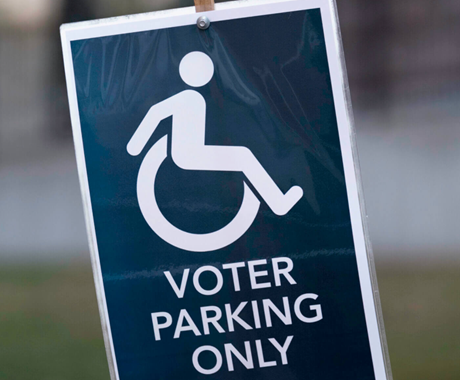
The Spring General Election in Wisconsin is on April 7. There will be one statewide race for a seat on the Wisconsin Supreme Court on the ballot. There will also probably be several local offices up for election, depending on where you live. It is important that you have a plan in place for casting your ballot. You should also make sure you know your voting rights. Last month, we wrote about getting registered to vote and getting a photo ID. Once you have registered and have the proper ID, you can begin to think about how you will cast your ballot.
Absentee ballots can be returned by mail or placed in an absentee ballot drop box if there is one in your community, but they must be delivered to your polling place or central count facility by 8 p.m. on Election Day. If you have your mail-in absentee ballot, be sure to mail it as soon as possible to ensure that it arrives in time to be counted. Absentee ballots in Wisconsin are not accessible, but local clerks will often provide a large print or braille ballot if you request one far enough in advance. If you want a large print or braille ballot, allow plenty of extra time to receive your ballot, as it can take significantly longer for the clerk to provide one. This is especially true with braille ballots, as the clerk may need to work with the independent nonprofit Audio & Braille Literacy Enhancement (ABLE) to create it.
You can return your ballot in person to either your clerk or polling location, or you can have an assistant of your choice return it for you if you are unable to return it yourself. If an assistant is returning your ballot for you, they simply need to tell the poll worker they are returning the ballot on behalf of a voter with a disability. Poll workers are only allowed to ask your assistant two questions: “Is this your ballot?” and if the answer is no, “Are you returning the ballot on behalf of someone with a disability?”
If you haven’t already requested an absentee ballot for the April election, remember that it can take up to two weeks for it to arrive in the mail and another two weeks to send it back. That means if you wait too long to request your ballot, it may not get to your polling place in time to be counted. Instead, consider voting in-person absentee at a time that is convenient for you. In-person absentee voting begins March 24 and will go until April 5. In-person absentee voting can be done at your local clerk’s office and potentially at other locations in your community. In-person absentee voting works similarly to voting in-person on Election Day, except instead of putting your ballot into the tabulating machine, it is placed in an envelope to be opened and counted on Election Day. In addition to being certain that your vote will be counted on Election Day, in-person absentee voting gives you more flexibility in deciding when to vote.
A big part of your voting plan is figuring out your transportation to and from the polls. Make sure you have a backup plan in case of bad weather or other unexpected situations that may disrupt your travel. One of the benefits of voting in-person absentee is that if your transportation plan doesn’t work out, you can still make arrangements to cast your ballot on another day.
As part of your voting plan, you should know your rights as a voter with disabilities. All voters are allowed to use a voting machine to mark their ballot on Election Day. These machines serve as a screen reader and magnifier that can mark and print a completed ballot, allowing voters with print-related disabilities to cast their ballot privately and securely. Voters with disabilities are also allowed to have an assistant help fill out their ballot for them. Your assistant can be anyone of your choosing except your boss or union steward or a candidate on the ballot. Anyone else can be an assistant, including a poll worker at your polling place. Your assistant does not have to be registered to vote. They can even be a minor under the age of 18.
Unfortunately, voters with disabilities may encounter barriers at their polling place. If you run into an issue at the polls, you should politely but firmly inform the poll worker of your rights and what accommodations you need to cast your ballot. You don’t need to apologize for asserting your rights. You do not need to disclose your disability if you are asked. You only have to state that you have a disability and need a particular accommodation.
The most common barrier with accessible voting machines will be that they are not properly set up and ready for use when you arrive. The machines should be set up with headphones, a ballot marking device, a chair, and should be in a private place within the polling area so that others can’t see the screen. If the machine is not properly set up, ask the poll worker or chief polling inspector to do what is needed. While the machines should be offered to every voter, that might not happen every time you go to your polling place. If it isn’t offered, simply ask to use the voting machine.
If a poll worker has any hesitancy about your use of a voting assistant, or to being an assistant themselves, tell them that both state and federal law give voters with disabilities the right to ask for assistance from someone of their choosing. If you are still running into issues, ask to talk to the chief polling inspector who oversees the polling place. If the issue still isn’t resolved, ask the chief inspector to contact your local clerk. Remember to stay calm, kind and firm in asserting your rights.
If you are unable to resolve an issue at your polling place, call the Disability Rights Wisconsin Voter Hotline at 844-347-8683. You can learn more about the upcoming Spring General Election, including what will be on your ballot, on the MyVote Wisconsin website.