
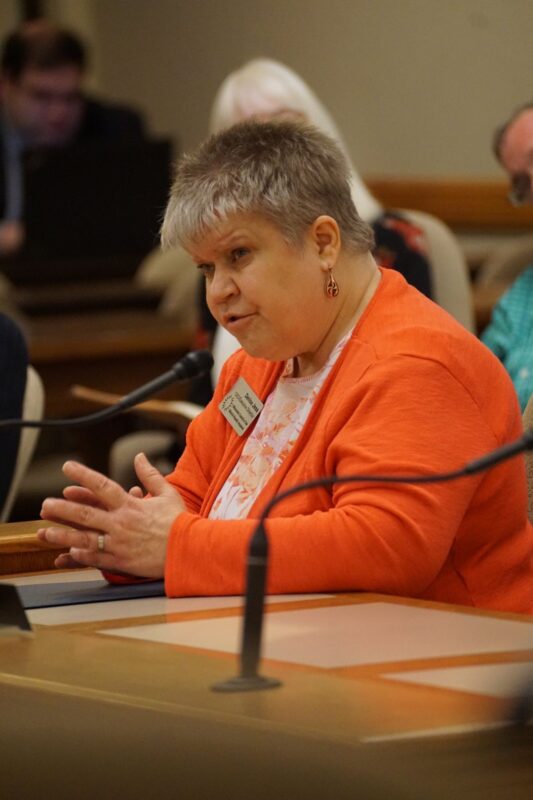
Executive Director Denise Jess testifying on a bill at a legislative hearing.
Since our founding in 1952, public policy advocacy has been a core component of the Council’s mission. As a 501(c)(3) nonprofit organization, we are bound by strict rules about how we go about lobbying and advocacy. Abiding by these rules keeps the Council in compliance with the law and protects our nonprofit status, but it also helps guide us in our work.
“When we think about our key pillars of education and advocacy, along with our mission of promoting dignity and empowerment, the guardrails in place are central to our mission,” says Executive Director Denise Jess. “We represent all Wisconsinites with vision loss, no matter their political leaning. So when we advocate for legislation, we work with those who are making the big decisions, regardless of their party affiliation, in a way that both follows the law and gives us a seat at the table.”
The rules about how much advocacy nonprofits can engage in without jeopardizing their nonprofit status have always been murky. But a bill passed by Congress in the mid-1970s clarified the matter a bit, spelling out how much of our budget we can spend on advocacy activities. The limits on lobbying lawmakers directly remain somewhat vague—we cannot dedicate a “substantial” amount of time to it—but like most other organizations, we track our advocacy time carefully throughout the year and stay comfortably within those boundaries.
Even if it’s not for a “substantial” amount of time, there are still limits on our advocacy. The purpose of these guardrails is to ensure that we do not become a partisan organization. So while we can advocate for or against pieces of legislation, we cannot publicly support or oppose political candidates. For example, we can meet with policymakers to educate them about the issues surrounding certain legislation, testify at public hearings, and talk about policies we support or oppose, but we cannot raise funds for or make campaign contributions to candidates running for office. And we are not allowed to compare the Council’s position on an issue to that of someone running for office. The National Association for the Education of Young Children provides a great list of advocacy dos and don’ts for nonprofits on their website. As a statewide nonpartisan organization representing all Wisconsinites who are blind or low vision, we easily follow these rules simply by living our mission.
Advocacy means more than just lobbying. The Council dedicates much of our work toward educating lawmakers and the public instead of working as lobbyists. Our advocacy happens on a continuum, where we start by educating people on the issues, then advocate on those issues, and then directly lobby for or against specific legislation. The Council does not actively litigate legislation in court.
“We’ve shifted our strategy over time to focus more on education and less on direct lobbying,” Denise says. “When we educate people about the issues instead of directly lobbying, we tend to have a bigger overall impact while making new allies in the Legislature who might not have listened to us if we only talked to them when we wanted them to vote a certain way. The issues that we work on aren’t going to be solved overnight; we have to be persistent in continuing to work with lawmakers and building relationships with them.”
Being perceived as partners rather than lobbyists helps us build credibility and further influence policy related to our mission. The guardrails that keep us from becoming a partisan entity also help form the basis of how we can be most effective as advocates.
To learn more about the Council’s advocacy and about our legislative priorities, visit the Advocacy page on our website at WCBlind.org/Advocacy.