
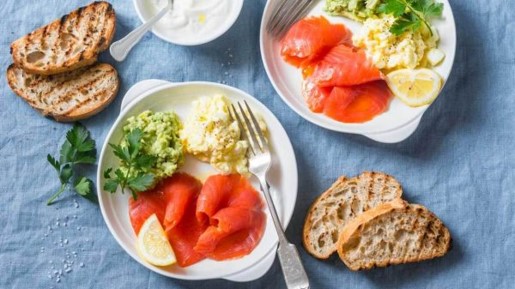
Dining with others is a great way to build community and share an intimate experience. Back in 2019, we published some tips and strategies to help people who are blind or low vision enjoy their dining experience with dignity and confidence. It has remained one of the most popular articles on our website ever since, so we decided to republish now, several years later, with some minor updates.
Locate Food Using the Clock Reference System:
One way to tell where food is on the plate, or the location of other dishes around the plate, is to use the clock reference system. Think of your plate as a clock face with 12:00 at the edge farthest from you and 6:00 at the edge closest to you. The right side would be 3:00 and the left side 9:00. Fellow diners or waitstaff can help you identify where items are situated by referring to the time location. For example, if a piece of chicken is at the edge of the plate nearest to you, someone could tell you it is at 6:00.
Eating Skills and Tips:
- If you have low vision, use high-contrast place settings for help in identifying tableware and food. For example, use a dark place mat with a light plate and cup. If serving darker foods, use a light-colored plate.
- A tray or place mat can help you navigate your dining area. Any shape tray or mat works. When you first sit down, find the edge of the placemat or tray and gently move your fingers around the edge and inside the edge. You are then aware of the eating area and the dishes and utensils within that space. By keeping your fingers close to the surface of the table, you are not likely to knock anything over. Returning items to their starting positions ensures that you know where they are without having to ask someone.
- Use a fork and tip of the knife to check the location and arrangement of the food on your plate periodically. Push food items back toward the center of the plate if they have shifted outward toward the edges.
- The tip of the knife can also give you an indication of the size of a piece of meat or other food item that requires cutting.
- The weight of the food on a fork or spoon can help indicate the size of the portion.
- Solid foods, such as bread or mashed potatoes, can serve as a “buffer” or barrier to help push food onto the fork. You can also use a knife as a buffer.
Cut Meat in Three Steps:
- Turn the plate so the meat is at the 6:00 position. Cutting is easier if you don’t have to reach over other foods to get at it.
- Locate one edge of the meat with the knife and keep the knife there. Put the fork into the chop about a half inch from the knife edge, and then starting at the edge, cut a small semicircle around the fork.
- Keep the knife at the edge of the meat while you eat the piece you have cut. Then repeat the process.
For Spreading and Serving:
- Glide the knife blade lightly across the top of butter to get an idea of where to cut into it.
- Some things, such as peanut butter, are easier to spread with a spoon.
- When eating family style, ask what dish you are receiving. When you pass it on, also tell the next person what the dish is. This will remind the people at the table to identify the dishes.
- When serving yourself, run fingertips around the top rim of the bowl to locate the serving spoon. If possible, place the serving dish on the table next to the plate. If not, hold the serving dish just above the plate and a bit to the side. This will make it easier to transfer the food.
Salt, Pepper and Other Seasonings:
To help differentiate salt from pepper, take into account that salt weighs more than pepper, and they make different sounds when shaken. To control the flow of salt, shake some into your palm and explore the amount with a pinky finger. You can also pour salt into the palm and pinch a small amount onto food.
Liquid Pouring Techniques:
- Place an index finger over the rim of the cup or glass, extending the top portion of the finger into the cup or glass. Pour the liquid until you feel it contact the tip of your finger. Stop pouring when the liquid is about an inch from the rim. (Note: This technique should only be used with cold liquids. For hot beverages, use a liquid level indicator, a device that makes noise when liquid touches it.)
- Before tipping a pitcher to pour, bring the pitcher spout up and touch it to the rim of the cup. Then tip the pitcher to pour.
- Listen for the sound of liquid as it enters the cup or glass, as well as for sound changes as the liquid approaches the rim.
- Wrap a hand around the cup or glass and feel for temperature changes as liquid level rises.
The Sharper Vision Store carries a number of adaptive products to help people with vision loss eat with confidence. You can find them online at Store.WCBlind.org/Store/Kitchen and in our physical store in Madison.