
Fall election season is almost here, when voters across the state will cast their ballots for a number of important statewide and local elections. The partisan primary election is on August 11, with the general election taking place November 3. As you head to the polls on Election Day, voters with disabilities need to be prepared to assert their rights so that they can have a confident and positive voting experience.
The first potential barrier for voters with disabilities voting in person is the front door. Polling places should be clearly marked and free from snow and other debris that could hinder one’s ability to enter. There should be large print signage clearly telling you where the voting is taking place. Polling places should have a greeter on hand to help any voter figure out where to go and what lines to stand in. Once you’re in the right spot, you will have to stand in one or more lines organized by last name and voting ward to sign in. These lines should also be clearly marked with large print signage. If you are unable to read these signs, don’t hesitate to ask a greeter for assistance in finding the correct line.
Once you’ve made it to the front of the line, you will have to sign the poll book to indicate that you are the one casting your ballot. Voters who are blind or low vision can use a signature guide to indicate where they need to sign. Poll workers should have a signature guide on hand to assist voters with vision loss, but this is not always the case. While voters with vision loss should not have to bring their own equipment to vote, being prepared and bringing a signature guide of your own can help you sign the poll book if one is not provided. Otherwise, you can use your photo ID to help mark where you need to sign. If your polling place uses the digital Badger Book as their poll book, the poll worker may need to point to the signature line directly on the screen.
Poll workers can receive assistive devices free of charge to help voters with disabilities cast their ballots securely, but these tools are not given automatically and must be requested by the election clerk. If your polling place does not have adaptive equipment like a signature guide, ask your local clerk to request them from the Election Commission.
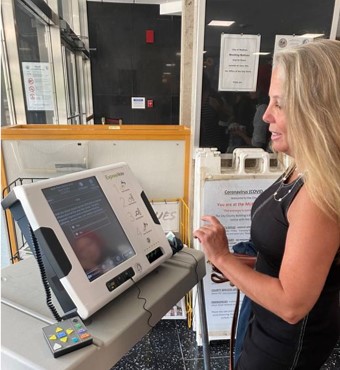
Once you’ve signed the poll book, it’s time to cast your ballot. The accessible touch screen ballot marking device allows voters to fill out their ballot without needing to use pen and paper. Poll workers should offer you the electronic ballot marker to cast your ballot, but you can also ask for it directly if they forget. The machine allows you to adjust the font size or contrast of your ballot on the screen or read the options on your ballot audibly using a screen reader. If you choose the screen reader option, a poll worker should offer you headphones to allow you to vote privately. Like a signature guide, it’s best to be prepared and bring your own headphones in case they are not available at the polling place. If headphones are available, use wet wipes to sanitize them before placing them on your ears.
These machines are great for voters with print-related disabilities, including those who are blind or low vision. But anybody can use them! Some brands of these devices print out ballots that are a different size from the paper ballots you mark manually with a pen. That means that if only one or two voters with disabilities use the machine, their anonymity may be compromised. That’s one of the reasons we encourage everyone to use the touch screen accessible ballot marking device at their polling place, regardless of whether they have a disability.
Voters with disabilities are also allowed to have an assister help them sign the poll book or fill out their ballot. An assister can be anyone of the voter’s choosing—including people who are not able to vote themselves—except for their boss or union representative. A poll worker may serve as your voting assistant. If a poll worker is hesitant to serve as your assister, politely but firmly inform them of your rights and what accommodations you need to cast your ballot. You don’t need to apologize for asserting your rights. You do not need to disclose your disability if asked; you only need to state that you have a disability and need a particular accommodation.
Once your ballot is filled out, whether by the touch screen accessible ballot marking device or by an assister, you need to place it in the tabulator. Keep in mind that some ballots are different sizes and can jam the machine if placed in the wrong slot. There should be a poll worker standing near the machine who can help make sure you are inserting your ballot correctly.
If you encounter a barrier at any point in the voting process, it is important to know who to talk to so your issue can be resolved. Start by explaining the issue to the nearest poll worker. If they are unsure about what accommodation they can provide, ask to talk to the chief inspector who oversees the polling place. If the issue still isn’t resolved, ask the chief inspector to contact your local clerk. Remember to stay calm, kind and firm in asserting your rights.
If you are unable to resolve an issue at your polling place, call the Disability Rights Wisconsin Voter Hotline at 844-347-8683. You can also contact the Wisconsin Election Commission’s toll-free voter help line at 866-868-3947. You can learn more about the upcoming fall elections, including what will be on your ballot, on the MyVote Wisconsin website.