
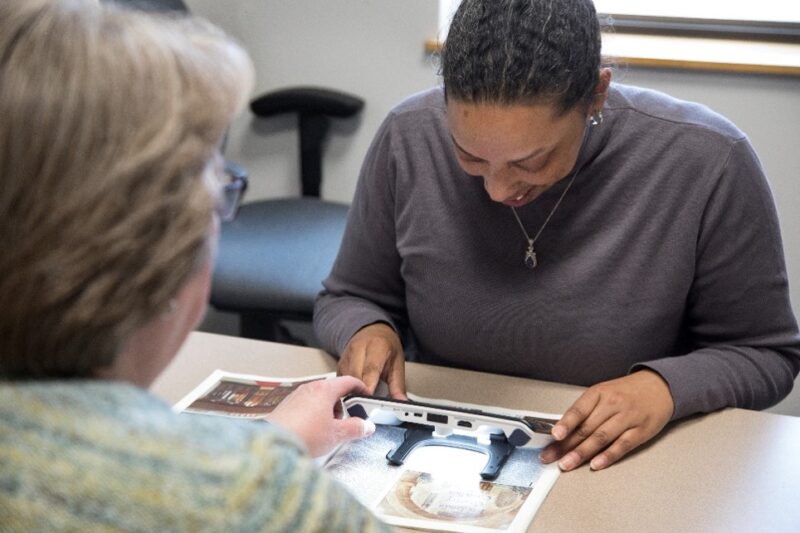
As you begin to experience vision loss, it’s important to have a team of vision experts to best meet your needs. Your team should include both a low vision optometrist and a low vision therapist. While these professionals have similar roles in addressing your vision loss, each offers a unique set of services that are most effective when they work in tandem to fully address your vision needs.
A low vision optometrist is a health care specialist who works in a clinic to help their patients maximize whatever vision they have. These professionals go through the same training as other optometrists but receive additional training to learn skills and tools that enable their examinations to address the impact of vision loss in patients’ daily lives. Low vision optometrists perform vision evaluations to determine the best tools and magnifier strength for each individual.
Because they are more knowledgeable about low vision than a regular optometrist, they can often provide a more accurate examination for people with vision loss and determine what prescription would be most beneficial. They can give medical advice and refer people to the proper specialist when needed. They can guide some low vision rehabilitation, but only within a clinical setting. Instead, they will provide a rehabilitation plan based on their level of vision loss and their goals, and then refer the patient to the appropriate specialist or therapist for additional training.
A low vision therapist is also a trained specialist who helps people maximize their remaining vision. Low vision therapists earn a national certification to ensure they are applying the best practices to help people continue living as independently as possible after losing vision. A low vision therapist works outside of a healthcare setting. They can meet clients in their home or workplace to find practical adaptations that work with their lifestyle. While a low vision optometrist can show how magnifiers and proper lighting can help an individual, they are confined to a clinic, which likely has different lighting than the person’s home. In contrast, a low vision therapist can evaluate the actual home environment and help put the low vision optometrist’s recommendations into practice.
But a low vision therapist doesn’t just follow the plan created by a low vision optometrist. They can also provide their own low vision evaluation, which can be used to determine how to best address other vision rehabilitation goals outside of lighting and magnification. For example, a low vision therapist can work with a client in their kitchen to assess where bump dots may be useful on an appliance or on medication containers. Because they can conduct their own evaluation, a client doesn’t have to see a low vision optometrist before seeing a low vision therapist, though we do recommend it so that they can benefit from every resource that may be available to them. Low vision therapists work outside of a clinical setting and can therefore be more flexible in their schedule. They can work with a client several times over the course of a training in either their home, an outside office, or both.
There may be an occupational therapist (OT) who specializes in low vision working alongside a low vision optometrist within the same office. A low vision OT can provide many of the same services as a low vision therapist, and may be able to work more directly with your low vision optometrist for your needs.
When a person with low vision works with both a low vision optometrist and a low vision therapist, those professionals can work together to address their full range needs. By accessing one service from the healthcare field to get a better understanding of their vision loss and one service from the rehabilitation field to find practical solutions to address their needs, a person with vision loss can be confident that those needs are being met as effectively as possible. Every client’s needs are different, but one thing is the same for all of them: The trust, collaboration and balance between these two types of specialists helps ensure that each client receives the entire spectrum of care.
To learn more about low vision therapy at the Council, visit our vision services page at WCBlind.org/Vision-Services.