
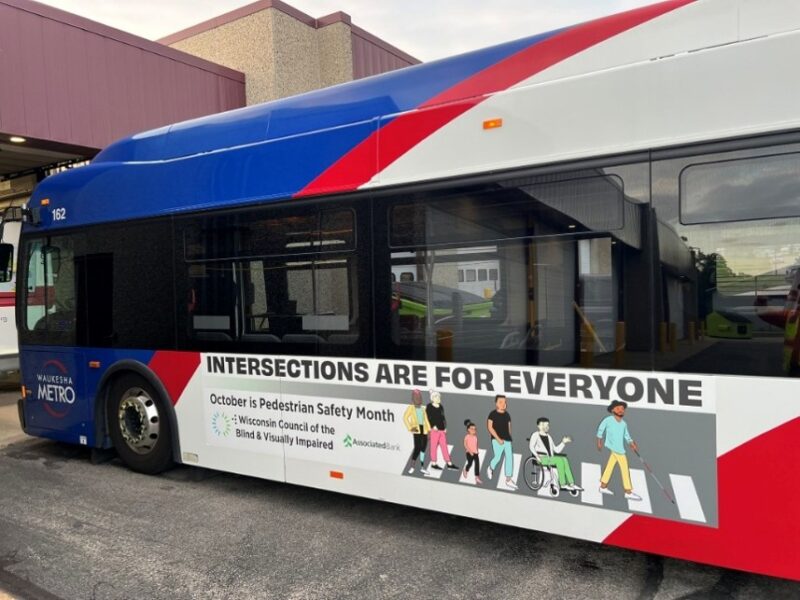
October is Pedestrian Safety Month, a time to promote safer and more welcoming communities for all. Everyone is a pedestrian some of the time, but for the 31% of Wisconsin residents who do not drive—including those who are blind or low vision—pedestrian safety is a critical issue that affects them every day. Wisconsin’s nondriver population is expected to grow dramatically in the coming years as people continue to live longer and become more likely to have a disability as they age. Throughout the month, we will be highlighting some of the critical pieces of pedestrian infrastructure that enhance safety on our Facebook and LinkedIn pages.
While many communities around Wisconsin are in the process of implementing good pedestrian infrastructure, the number of pedestrian accidents has not been declining. In fact, that number has been climbing steadily for years. In Dane County, pedestrian-vehicle accidents reached a five-year high in 2024, with a 20% increase over the previous four-year average. Statewide, pedestrian crashes have been increasing since 2020. Last year, 1,268 pedestrians were injured in crashes and 43 lost their lives. While good pedestrian infrastructure is a key part of the solution, drivers must also play an enormous role in reducing accidents involving pedestrians by remaining attentive and avoiding distractions.
One of the most important things drivers can do to keep pedestrians safe is to slow down. Slowing down by just five miles per hour can dramatically reduce the risk of serious injury or death in a crash with a pedestrian. Research has shown that if a car hits a pedestrian at 20 miles per hour, the pedestrian has a 13% chance of fatality or severe injury. At 30 miles per hour, that chance jumps to 40%, and at 40 mph the probability is 73%. Slowing down could save the life of a pedestrian while adding only a few minutes to the driver’s trip. Distracted driving also causes drivers to get into accidents with pedestrians. Drivers should put the phone away and leave the radio alone while driving.
Crosswalks are one of the most important pieces of pedestrian infrastructure, creating a clearly defined space in which to cross the street. Wisconsin law mandates that drivers yield for any pedestrian in a crosswalk. Wisconsin’s White Cane law goes even further, saying that drivers must stop at least 10 feet from any pedestrian carrying a white cane or using a guide dog. One of the most common issues pedestrians face in crosswalks, particularly at controlled intersections (such as those with a stoplight), is drivers who are stopped within the crosswalk, inching forward to be as close to the other side of the intersection as possible. This forces pedestrians to walk around the vehicle, often making them step into traffic. This is especially an issue for pedestrians who are blind and can’t see that a car is in their path until they collide. Drivers need to stop at the designated spot before the crosswalk to allow pedestrians to cross safely in front of their vehicle.
Another issue at traffic lights is drivers who rush to drive through a yellow light. The walk signal for pedestrians will change automatically when the light turns red for drivers, and an accessible traffic signal will audibly tell blind and low vision pedestrians when the walk light has come on. To keep pedestrians safe, drivers should slow down when they see a light turn yellow and wait for the light to cycle back to green before proceeding through the intersection.
Drivers turning right on red lights at controlled intersections can also pose a danger. Often, a driver trying to turn right on red will be looking to the left to see when there are no cars coming through the intersection, and don’t remember to look right to see if a pedestrian is trying to cross right in front of them. More and more communities are beginning to limit right turns on red to protect pedestrians. Even if they are legal in your community, make sure your path is clear from all directions, or just wait until the light turns green to make your turn.
Accessible pedestrian signals, placed at both traffic controlled and uncontrolled intersections, are a critical piece of pedestrian infrastructure. Here, pedestrians can press a button that will tell them when the walk signal has turned on and other information, such as street name. At uncontrolled intersections, the button will often also trigger rectangular rapid flashing beacons (RRFB) that will warn drivers that somebody is trying to cross the street. Far too often, drivers ignore these beacons and continue through the intersection without slowing down. When you see an RRFB begin to flash, slow to a stop and look for the pedestrian who is trying to cross. If the road with the accessible pedestrian signal has two lanes, never try to move into the other lane to get around stopped traffic. Always wait for the pedestrian to cross safely before proceeding.
Whether you’re a driver or a nondriver, please share this article and this information with the drivers in your life and encourage them to make smart driving decisions to keep pedestrians safe. You can learn more about Pedestrian Safety Month on our website.