
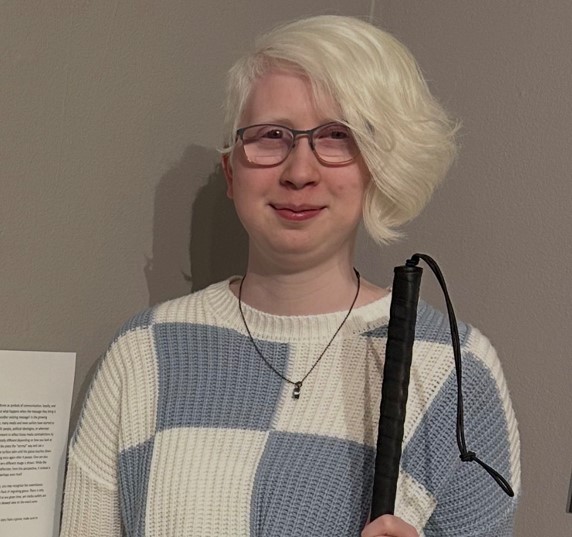
Emma Bjurquist
Council Scholarship recipient Emma Bjurquist says art has always been her life; her first word was even “purple.” The Prairie du Chien native says her artistic talent has grown a lot since she was young. Today, she works in nearly every medium, from painting to sewing to metal arts, and hopes to share her knowledge and passion with the next generation.
Emma is a fourth-year Arts Education major at UW-Whitewater, with the goal of becoming a high school art teacher after graduation. “In high school, I realized that I really enjoy sharing my joy of art and showing other people how they can create too,” Emma says. “I specifically want to teach high school because as a person with a disability, high school wasn’t a great time for me. I really appreciated the teachers who supported me, and I want to be that role model for students in my classroom.”
Emma’s art has been featured in galleries across the country. Earlier this year, she had the chance to visit Toledo when her work was featured in the Toledo Museum of Art’s “Disabled Women Make History (and Art)” exhibit. “It’s probably the most prestigious exhibit I’ve been a part of,” Emma says. “I got to attend some workshops and made a lot of connections with people who are interested in my art.”
Emma also has a piece that will be part of the Council’s 2026 Gallery Night exhibit. Her metal art piece, “Seeing is Believing,” challenges the audience to physically touch and interact with the braille on the piece to decode the question it asks. You can see and touch Emma’s piece for yourself at Gallery Night on Friday, November 6 at the Council offices.
Emma was born with albinism and has very limited vision. “This can make navigating daily life challenging, especially when outdoors or when the lighting isn’t ‘just right’ for my eyes,” Emma says. Every art medium she works in requires different adaptations. While she says she tends to ditch the paintbrushes and uses her hands to paint, that isn’t possible when creating sculptures out of hot metal. “A few years ago, I wouldn’t have believed that it would ever be possible to work in metal arts,” she says. “But I have wonderful professors and peers who support me. I obviously can’t use my hands when working with burning hot metal, so I have to rely on senses like sound instead. It takes me a bit longer to make things, but I don’t mind.”
Emma will use the Council scholarship to help pay for textbooks and transportation around her campus. The Council has been awarding scholarships to postsecondary students who are blind or low vision for most of its history. You can find more information about our scholarship program at WCBlind.org/Events/Scholarships.