
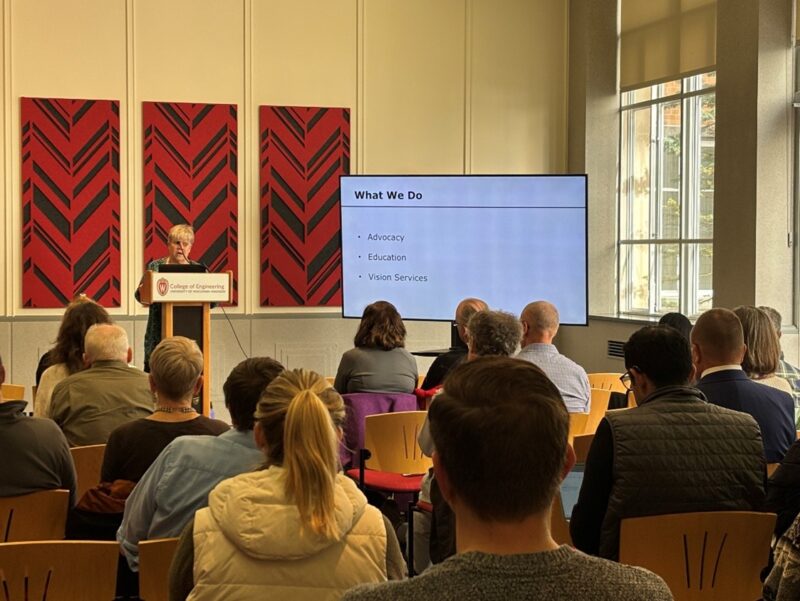
Denise Jess presenting to staff and faculty at the UW-Madison College of Engineering
Council staff go out into the community on a regular basis to spread the word about our mission to promote the dignity, independence and inherent worth of people who are blind or low vision; educate people about the many services we offer; and encourage others to do their part to make the world more welcoming for people with vision loss. For years, we have reached people at places and events like health fairs and senior centers, where eye health and adjusting to vision loss are common topics of discussion. But our education and outreach go much further than that. In recent years, our education and outreach mission has brought us before a number of new and unique audiences.
“Community and relationship building is a crucial part of the Council’s mission,” says Education & Outreach Coordinator Kathleen Callen. “We want as many people as possible to have access to our services and to feel welcome, and the best way of introducing ourselves is to get out into the community.”
The Council worked with a number of organizations to train staff on how they can better serve clients who are blind or low vision. We met with RISE Wisconsin, a Dane County organization that provides wraparound mental health services to children and their families, where we trained staff on how to better serve clients and their caregivers, parents and guardians with vision loss. At the Community Living Alliance in Madison, we educated staff and caregivers on inclusive caregiving and how to create an inclusive workplace. At Encompass Fitchburg, we conducted a training for rehabilitation staff, such as occupational and physical therapists, on inclusive patient care. We gave two presentations for staff at that state’s Office for the Blind and Visually Impaired (OBVI), one on the purpose of our new vision services navigator position and the other on access technology. At UW-Madison, we spoke with faculty and staff at the College of Engineering as part of their Distinguished Speaker Series about creating inclusive environments for learning and research for students, faculty and staff with disabilities. And we met with communications professionals across the UW-Madison campus on the importance of digital accessibility.
We also met with a number of high school and college students. Students training to become occupational therapists came to the Council to learn about the vision services career field. We also spoke with students from Madison East High School’s AVID college readiness program about career opportunities in the vision services field. We talked to members of the Wisconsin Center for the Blind and Visually Impaired’s College and Career class about what to expect in the working world after they graduate. We were invited to speak at the UW-Madison Department of Ophthalmology and Visual Sciences Grand Rounds on the critical role orientation and mobility plays in the continuum of care, and ways clinic and hospital staff can make their offices more accessible. At UW-Milwaukee, we spoke at the College of Engineering about ways they can highlight pedestrian safety in street design.
Advocacy has been a core part of our mission since our founding over 70 years ago, and we regularly meet with a wide variety of policymakers to promote our priorities. We gave presentations to the Wisconsin Department of Workforce Development’s Division of Vocational Rehabilitation (DVR) on the VisionServe Alliance’s Big Data Report on Working-Age Adults with Vision Loss and its implications for job training services. During the Week Without Driving in October, we gave presentations on pedestrian safety in Madison, Fitchburg and Sun Prairie centered around the book “When Driving is Not an Option” by Anna Ziverts. At the UW-Madison Disability Cultural Center, we teamed up with the Madison City Clerk’s office for a demonstration of accessible voting machines and highlighted materials provided by the Disability Vote Coalition. Executive Director Denise Jess was invited to speak before judges of all levels from around the state, including the Wisconsin Supreme Court, at the Wisconsin Judicial Conference on the importance of creating welcoming, compassionate and ADA compliant courtrooms that serve people with disabilities equitably. For Social Connection Week in November, Denise joined the Wisconsin Coalition for Social Connection for a webinar on the role neighborhoods and professional networks can play in supporting connection among older adults and people with disabilities. We also gave presentations to the Statutory Council on Blindness on the issues of interest to people with vision loss in the state budget and on the link between vision loss and mental health.
Our education and outreach efforts connect us with people across the entire state. We gave a virtual presentation to the Appleton Low Vision Support Group to help them learn more about the Council and to strengthen the connection between the group and the Council. We worked with the Southern Wisconsin Bird Alliance and the Aldo Leopold Nature Center to hold trainings to teach people how to lead birding by ear events in their own communities. We are working with the Center for Deaf-Blind Persons in West Allis on a presentation on adaptive gardening.
No matter where we go or who we talk to, the Council works hard to educate people from all walks of life about how they can be a part of making their state, community, institution or profession more equitable for people with vision loss.