
This fall, voters will cast their ballots for several important statewide elections, including races for governor, lieutenant governor, attorney general, secretary of state, treasurer, and three constitutional amendment questions. There will also be local races across the state for seats in the Wisconsin Senate, the State Assembly and the U.S. House of Representatives. The partisan primary election will be on August 11, with the general election taking place on November 3. Voting absentee is one way for voters with disabilities to confidently cast their ballot, but there are a few important things absentee voters should know before they vote.
If you plan to vote absentee, it is important that you request your ballot as soon as possible. It can take up to two weeks for your ballot to be mailed to you, and it can take another two weeks for it to arrive at your polling place once you put your completed ballot in the mail. You can request an absentee ballot either in person at your local clerk’s office or online on the MyVote Wisconsin website. If you request your absentee ballot through the MyVote website, you can request a ballot for both the August primary and November general election at the same time. Local clerks may be able to provide voters with disabilities large print or braille ballots if requested far enough in advance. Large print and braille ballots cannot be requested through MyVote. It’s important to request a large print or braille ballot now so that they can work to provide you with one in time to vote.
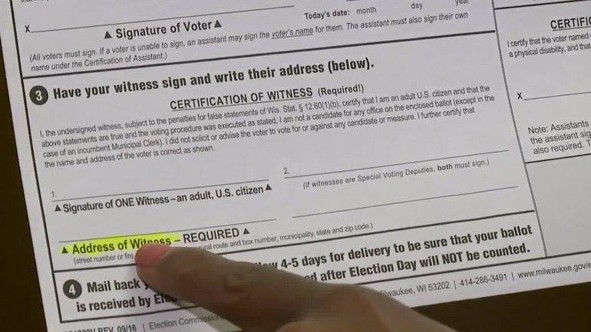
Once you have your absentee ballot, you should fill it out as soon as possible to allow ample time for it to get back to your clerk or polling place to be counted. To vote absentee, you must have a witness confirm that you are the one who has marked your ballot. Your witness must fill out the entire witness section of the ballot, including their full address and signature. If any of this information is missing, your ballot may be rejected.
Voters with disabilities are allowed to have an assistor of their choice help them fill out their paper ballot. Currently, only paper absentee ballots can be sent to voters. Unfortunately, Wisconsin’s paper absentee ballots are inaccessible to people who are blind or low vision or have other print-related disabilities. Just like a witness, your assistor also needs to fill out their section of the absentee ballot with their address and signature. Your assistor and your witness can be the same person, but if that’s the case, they must fill out both of these sections with their full address and signature. If they fill out only the assistor section or only the witness section of the ballot, it may be rejected. Your assistor can be anybody you choose except your employer or union representative.
You have several options when it comes time to return your ballot. One of the easiest ways is to return it by mail. If you choose to mail back your ballot, make sure to do so at least ten business days before Election Day to ensure that it arrives at your clerk’s office or your polling place by 8 p.m. on Election Day. If there are delays in the postal service and your ballot doesn’t arrive in time, your vote will not be counted.
You can also return your ballot in person to your clerk’s office any time, or to your polling place on Election Day. If there is an absentee ballot drop box in your community, you can also deposit it there any time. Most ballots need to be dropped off by the voter themselves, but voters with disabilities are allowed to have somebody else drop off their ballot for them. The same assistor rules noted above apply. If an assistor is returning your ballot for you, they simply need to tell the poll worker they are returning the ballot on behalf of a voter with a disability. Poll workers are only allowed to ask your assistant two questions: First, “Is this your ballot?” And if the answer is “no,” then they may ask “Are you returning the ballot on behalf of someone with a disability?” This is the only information your assistor needs to give. They should not feel compelled to describe your disability or why you cannot return the ballot yourself.
You can learn more about absentee voting in Wisconsin and request your ballot for the entire year on the MyVote Wisconsin website. To learn more about your rights as a voter with a disability, visit the Wisconsin Disability Vote Coalition website.