
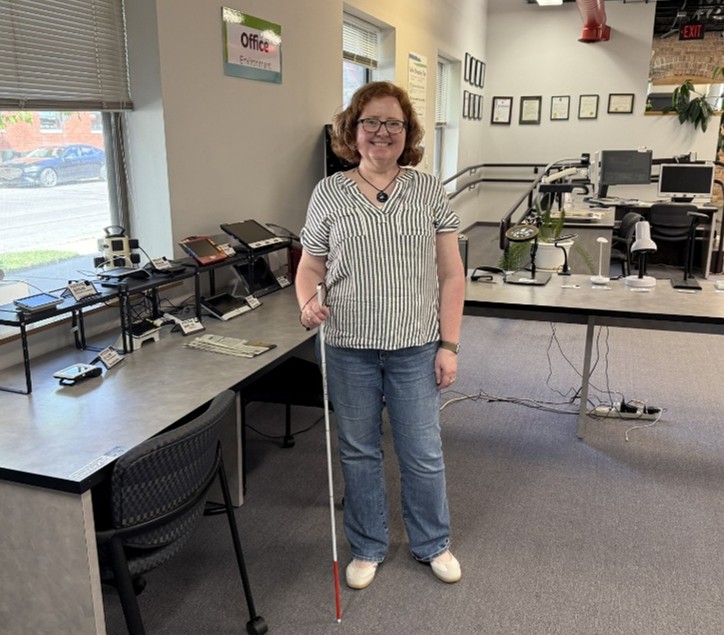
Kathleen Callen
Like many people, Education & Outreach Coordinator Kathleen Callen of the Council has never enjoyed going to the airport. Moving through the busy, winding hallways became even more daunting as her vision declined and she struggled to read signs directing her where to go. While she has enough vision to walk to where she needs to go safely, she began carrying a white cane in airports and in unfamiliar cities to let others know she had low vision.
“I consider myself a very situational white cane user,” Kathleen says. “It was very frustrating when I’d ask people for directions and they’d tell me to just ‘follow the signs,’ because I couldn’t see the signs. My cane lets people know that I might need to move slowly or get really close to signs to read them. It’s a great tool to reduce my overall stress in busy, unfamiliar areas.”
Since the early 1920s, white canes have been used by people who are blind or low vision to both help them navigate safely through their homes and communities and to signify to others that they have vision loss. However, there remains a myth, even among people with vision loss, that white canes are only for people who are completely blind. That could not be farther from the truth. In reality, white canes can be useful to people with all levels of vision loss, even if only in certain situations.
“Even if you have a certain amount of functional vision, traveling can still be dangerous,” says Certified Orientation and Mobility Specialist Brent Perzentka. “More often than not, people with vision loss can really benefit from having a cane available when they need it.”
There are a few different kinds of white canes, each best suited for a particular purpose. When most people think of a cane used by a blind or low vision individual, they usually picture the classic white mobility cane. This cane is swept across the ground in an arc to help the user detect obstacles in front of them. But that’s not the only type of white cane. A white ID cane’s main purpose is to inform people around the user that they are blind or low vision. White support canes help people with both vision loss and balance or stability issues stay on their feet. Both of these types of cane are designed to enable people with some usable vision to feel more confident as they navigate their various environments.
Even if you are able to move safely through your community most of the time, there may be particular situations where a white cane can be extremely helpful. For example, you may have no problem walking through your neighborhood on bright sunny days, but on cloudy days or at night you may not be able to see cracks in the sidewalk or other obstacles in your path. Keeping a foldable mobility cane on hand enables you to travel safely any time of day, regardless of whether the sun is shining. An individual with reduced peripheral vision due to retinitis pigmentosa may be able to walk down a street when there’s nobody else around but struggle when the street is crowded. A white ID cane tells those around you that you have low vision and could be startled by someone suddenly appearing in your field of view.
Despite their usefulness, some people are hesitant to use a cane for emotional reasons. “I hear people say, ‘I don’t need a cane because I’m not totally blind’ all the time,” Brent says. “That cane identifies you as someone who is blind or low vision, and unfortunately there are a lot of stigma and negative emotions surrounding that. But accepting that you need a cane is so important. It’s a tool that, even if you have some usable vision, helps you know your surroundings and helps keep you safe and stable.”
“I already keep a flashlight and magnifier with me, and my cane is just another tool that helps me in certain situations,” Kathleen says. “I’ll admit that I felt hesitation before using my white cane for the first time, but it’s been nothing but positive. I would really encourage people with vision loss to give it a try. At the end of the day, it makes my life easier and lets me move confidently.”
The Council’s White Cane Program provides white canes to blind or low vision Wisconsin residents at no cost to the user. You can learn more, including how to get your first white cane, on our website at WCBlind.org/Vision-Services/Free-White-Cane-Policy. These canes are funded by our generous donors through our White Cane Fund. You can give to the White Cane Fund by visiting our website at WCBlind.org/Donate.