
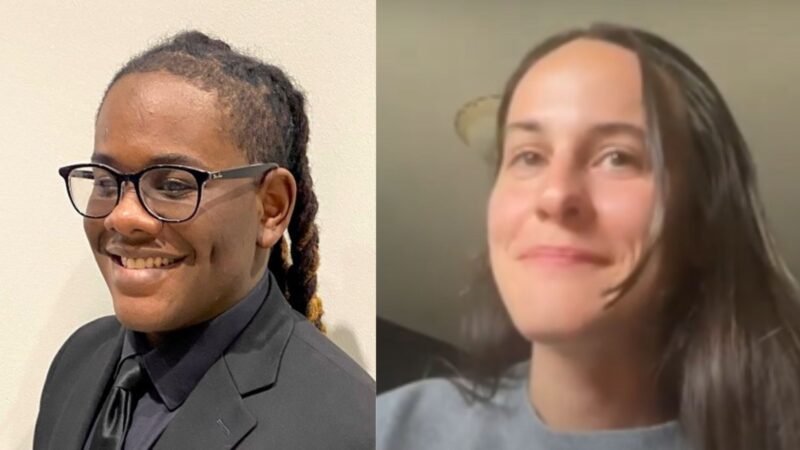
Jayquan Jaeger and Mia Zutter
Graduating high school and starting postsecondary education can be both exciting and challenging. That’s especially true for students with vision loss who are leaving behind their teachers of the visually impaired and navigating school on their own for the first time. They will encounter some new barriers and obstacles, whether they go to a four-year university or a trade school. But students with disabilities have rights in the classroom and around campus, and asserting those rights can help ensure they get the education and postsecondary experience they are hoping for.
“After high school, students don’t have someone that can look after them to make sure their rights are being protected and they are getting an equitable education,” says Executive Director Denise Jess. “It’s a big change, and students need to be able to advocate for themselves and assert their rights. Pushback will happen, and it can quickly become overwhelming. But students with vision loss have and will continue to succeed after high school if they have the tools to do so.”
There are two main federal laws that protect the rights of students with disabilities. The first is the Americans with Disabilities Act (ADA). First enacted in 1990, the ADA says that schools cannot discriminate against students with disabilities upon admittance. While all public universities must follow the ADA, some private religious colleges may argue they are not bound by it. The second law is section 504 of the Rehabilitation Act, which prohibits discrimination against people with disabilities in any program receiving federal funds. The two laws overlap in several areas, together providing significant legal protections for postsecondary students with disabilities.
By law, college campuses must be accessible to everyone. While people with different disabilities will benefit from different accessibility standards, there is overlap in these designs. For example, buildings must have wheelchair accessible entrances, usually in the form of a ramp in addition to stairs. This helps cane users as well, since most ramps are safer to navigate than stairs. The law also says that signs around campus must be accessible both outside and in buildings. That means they are supposed to be at eye level and should include braille. If a student has a guide dog, they must be allowed to have that guide dog live with them in the dorm and bring the dog anywhere on campus.
In the classroom, federal law says that all digital materials must be fully accessible under the Web Content Accessibility Guidelines 2.0 within the next year. In Wisconsin, State Statute 106.57 provides that students with disabilities are entitled to ask for most instructional material, such as textbooks or other handouts, in an alternative or electronic format. Students should reach out to their professors and instructors as soon as possible so they can gather the digital materials before classes begin. Students with disabilities are also entitled to reasonable accommodations in the classroom. For students with vision loss, that could mean using adaptive technology or having a notetaker with them in the classroom. To best get reasonable accommodations, students need to reach out to professors before the class begins to discuss what they need.
Students with disabilities are entitled to reasonable accommodations in science labs as well. For students with vision loss, this could be things like beakers with tactile markings. Students may need to educate their professors about how to make things accessible. If a student knows that bump dots or puff paint will be helpful in the lab, they should bring those items with them to show their instructors how they work. “You don’t want your professors to have to guess what will work,” Denise says. “They might guess correctly and be helpful, but they might also guess wrong. Just showing them will take out the guesswork.”
While all students with disabilities are supposed to have equal access both in the classroom and around campus, the reality is that barriers still exist. Students with vision loss will need to put in the effort to advocate for all the accommodations they need. Even before applying to a school, students should ask administrators about what they can expect. Once accepted, they should reach out to campus staff as soon as possible to inform them that they are blind or low vision and tell them what accommodations they will need to thrive.
Realistically, accommodations will not be available in every situation, and issues will arise. Not every classroom will be fully accessible, especially on older campuses.
Former Council Scholarship recipient Jayquan Jaeger says his biggest barrier, unexpectedly, was stairs. While the stairs around his campus were technically accessible to him, he learned that two sets of stairs could be very different. While he could safely navigate some stairwells, others were difficult and unsafe. It was unlikely Jayquan could have the school adjust all the stairs around campus to be uniformly accessible, so he had to take other actions to get to where he needed to go. If there was a ramp or elevator, he would use those instead. If he used a set of stairs regularly, he could memorize the number of steps he took to avoid tripping. If it was dark and stairs had poor contrast, he would utilize the help of a friend to help him up and down the stairs.
Scholarship Recipient Mia Zutter says she was able to access all her written class materials easily enough in her dorm, but not quite as easily in her lectures. Mia needed both her laptop for taking notes and an iPad for following along in her textbook. Classroom desks are small, and Mia would find herself buried in her technology. She couldn’t get a bigger desk in these classrooms because none was available. Instead, she pushed two desks together so she could have room for everything she needed to stay focused in her lectures.
Students with vision loss can succeed and thrive in postsecondary education, but they need to assert their rights and advocate for the accommodations they need and deserve.