
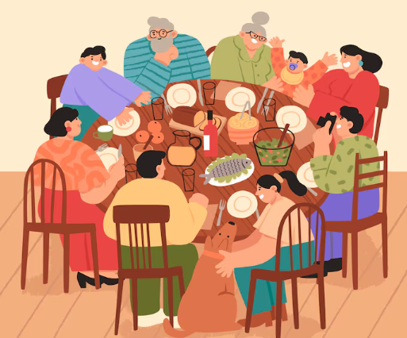
The holiday season is almost here. That often means gathering with family and friends for meals and parties. For people with vision loss, this can create challenges as they may struggle to socialize in the ways they used to before their vision declined. Fortunately, there are strategies making these gatherings more comfortable and maintaining those important connections.
Some people may not realize how much communication is done visually until they begin to lose their vision. For example, the most common way to know who somebody is talking to is to see who they are looking at. For people who are blind or low vision, especially those who are new to vision loss, this can cause them to feel shut out of conversations. It can create awkward gaps when they don’t realize a family member is talking to them. To avoid that awkwardness when you are in a group of people, ask them to address you by name when they are talking to you so that you know when it is your turn to contribute to the conversation.
Taylor Lancaster of Madison was diagnosed with retinitis pigmentosa about four years ago. She says her peripheral vision is very poor and she has issues with contrast and changes in lighting. “Being in a big group setting can be really overwhelming,” Taylor says. “I like to sit with my back to the wall so that the voices are all coming in front of me, and I ask people to always address me by name when they’re talking to me.”
Another issue at gatherings is people underestimating your capabilities as a person with vision loss. You may find them acting almost as a caregiver and assuming you can’t do anything. At the other end of the spectrum, they may leave you to figure everything out on your own without understand how they can easily make you feel more included. Be clear and firm with what you need. If you’re sitting around a table and dishes are being passed, let people know if you would like to have the dish described to you so you know what you’re eating. If the gathering is a potluck style dinner and people say “You don’t need to bring anything,” speak up if you want to bring a dish to share. If your group gathers to watch a sporting event on TV, let the people know how much of the action you’d like to have described to you and how much you can gather from the TV audio.
“My family is so wonderful, but at first they would just do stuff for me,” Taylor says. “Now, there’s a lot of asking questions instead of them just doing things for me. For example, contrast is hard for me, so now they ask me what color plate would help me best see what I’m eating.”
Everyone’s family is a little bit different, and the way you talk to each other will change from gathering to gathering. But it’s important to assert what you need in whatever way you’re comfortable. Your vision loss does not remove your ability to fully participate in gatherings, but you may need to find new strategies and adaptations to continue your family traditions.
“It was important to understand that both my family and I were grieving my loss of vision,” Taylor says. “I had to have a hard conversation with them where I said ‘I know you guys are doing this from a place of love, and I appreciate that, but I don’t want to lose my independence.’ We work through situations together, and what I’m capable of doing changes over time. There’s a time and space for that conversation; we needed to all be open to being able to really hear each other.”
One thing that Taylor says helped her was participating in a low vision support group where she could hear from her peers about how they navigate social situations. As member of the Council’s online Supernovas group for college and working-age adults, she says she’s learned so much just by talking to others in the same situation as her. The Council also hosts the Trailblazers group, also online, for adults of all ages. In addition to the Council’s groups, there are a number of other low vision support groups around the state, both in-person and online. Another online option is Hadley, which hosts virtual discussion groups and peer-to-peer support that can help you connect with someone who can relate to the everyday challenges of vision loss. You can learn more about Hadley at HadleyHelps.org.