
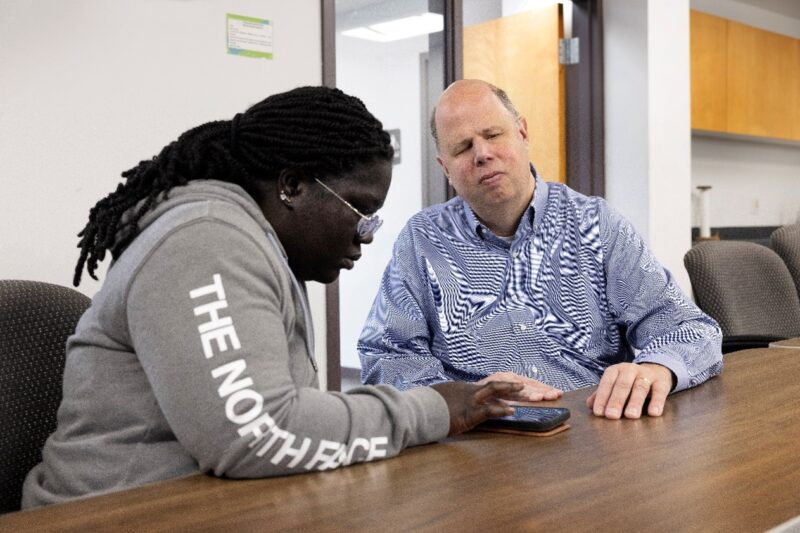
Access Technology Specialist Jim Denham working on mobile device skills with client Mikayla Mobley.
As the number of people who are blind or low vision in Wisconsin continues to grow, access technology (AT) is becoming increasingly important in helping people with vision loss live their lives on their own terms. Technology evolves rapidly, and innovations in the AT world are constantly offering new tools for more equitable access to information and communication.
In late June, Access Technology Specialist Jim Denham and Executive Director Denise Jess gave a presentation to Wisconsin’s Assistive Technology Program (WisTech) on the current state of AT for people who are blind or low vision and the advocacy work being done to get those tools into the hands of people with vision loss. Jim serves on WisTech’s Advisory Board, which guides the program to connect people with disabilities with the technology they need to be more independent in their education, employment and daily living activities. Read on for a summary of the information covered in the presentation.
Some AT programs have been around for years and can be built directly into computers’ operating systems. Screen magnifiers and enhancement tools, like ZoomText and Windows Magnifier, can enlarge the content on the screen and adjust contrast and color settings to be more visible to low vision users. Screen readers like JAWS, NVDA and VoiceOver convert on-screen information into speech or braille output and allow users to use their keyboard to navigate applications and websites. Many smartphones also have these types of features built in, enabling users with vision loss to use their mobile device right out of the box. These programs are continuing to improve each year, becoming more accurate and user-friendly.
Artificial intelligence (AI) is becoming an increasingly prominent component of AT. New applications and programs can use a smartphone’s camera to scan and read aloud printed documents or describe one’s physical surroundings. Others can scan an inaccessible web page and read its content. Smart glasses, such as Meta glasses and Echo Vision from Agiga, use cameras, AI and voice to provide hands-free access to visual information. As with any use of AI, users should always verify important information and take steps to protect their privacy and the privacy of others.
Using any of these programs or devices requires skills that can be taught by a certified AT specialist like Jim. AT instruction helps people select and use the technology best suited for their needs effectively and confidently, whether on the job or just to connect with friends.
For AT to be effective, website and digital documents need to be made fully accessible through proper labeling, headings and keyboard access. Unfortunately, many websites are not designed with accessibility in mind. This means AT users may struggle to access the same information that is readily available to their non-disabled peers, or may not be able to access that information at all.
Lack of website accessibility is unfortunately common in public government digital services. In 2010, the Americans with Disabilities Act (ADA) was amended to cover website accessibility, and in 2024 a rule was established requiring all levels of government to have a digital accessibility plan in place and implemented by 2026. That deadline was recently pushed back to April of 2027. The rule applies to all websites, documents and mobile apps created by any public entity in the United States.
The Council and other organizations within the disabilities community will continue to advocate for digital accessibility across all levels of government and to make AT accessible and available to anyone who may benefit. AT training, including the instruction provided by the Council, is not currently covered by Medicaid, Medicare or most private insurance. While the Council will never turn away a client due to inability to pay, providing these services has a cost. We will continue to advocate for insurance coverage of AT training so that more people can access these critical services.
You can learn more about these issues in the Legislative Priorities section of the Advocacy page of our website.
This above is an overview of the material covered in Jim and Denise’s WisTech presentation. You can watch the full presentation at https://www.youtube.com/watch?v=w6mo3SppXFc.